Water Body
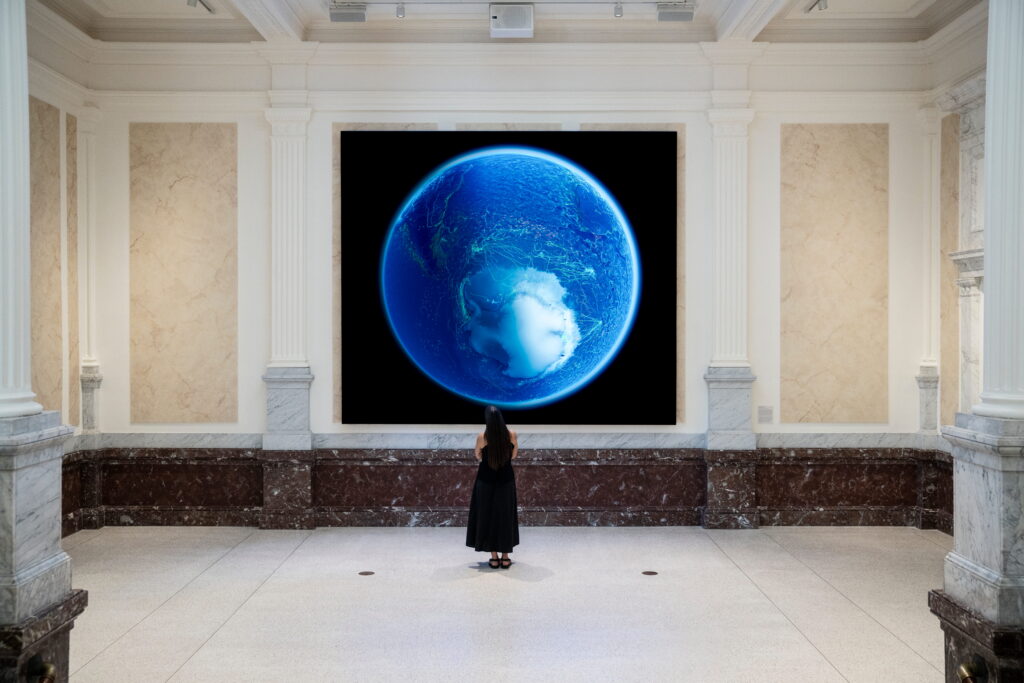
Water Body is an immersive installation revealing the circulation of water across the surface of the Earth. Through large-scale visualisation, spatial sound, and scientific data, the artwork invites visitors on a sensory journey through the branching pathways of ocean currents, river networks, and the migrations of species that move within them, unveiling water as a living planetary system.
Water Body at the 70th Bfi London Film Festival, Expanded
Inspired by Robert Macfarlane’s groundbreaking book Is a River Alive?, the work of the MOTH program (NYU), and originally commissioned by ARTIS Amsterdam Royal Zoo, Water Body comes to London as the Special Presentation of LFF Expanded, the BFI London Film Festival’s programme of immersive art, extended reality and video games.
3 to 18 October, 12:30-21:00
St Martin-in-the-Fields, Trafalgar Square, London
Tickets
We have become increasingly waterproofed: conceptually sealed against subtle and various relations with rivers, even as they continue to irrigate our bodies, thoughts, songs and stories. Rivers run through people as surely as they run through places. – Robert Macfarlane, 2025. Is a River Alive?
Water Body is a meditation on water as a planetary circulation: a living network of exchange that connects climate, ecosystems, and life across the Earth. It is an invitation to witness water not as a resource or a static object, but as a dynamic process that continuously moves through rivers, oceans, atmosphere, living bodies, and landscapes, binding them into a web of interdependence.
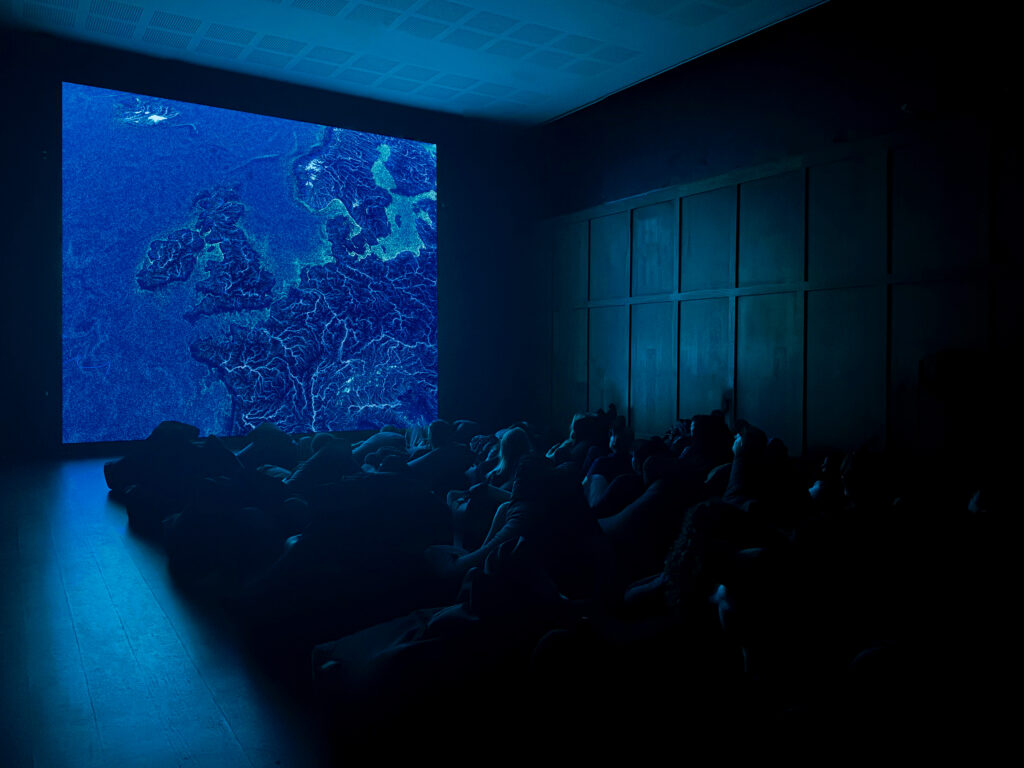
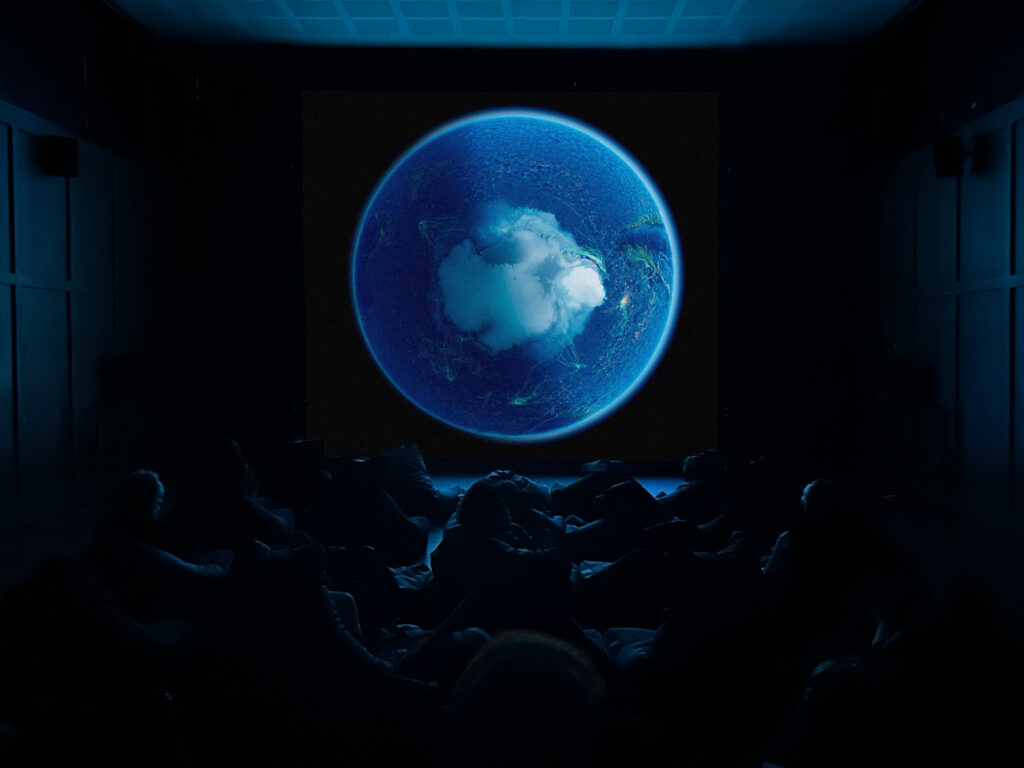
Drawing on scientific datasets, a year of planetary water movement is compressed into ten seconds. Cycles of wet and dry seasons unfold as rivers swell and retreat, ocean currents weave between continents, nutrients travel through watersheds, and phytoplankton blooms emerge across the seas. These processes ripple through the food web, shaping the ancient migratory routes of whales, seabirds, and other marine species that depend upon them.
Water Body is Marshmallow Laser Feast’s inquiry into the hidden rhythms and invisible structures of the Earth’s hydrological systems. Commissioned by ARTIS Amsterdam Royal Zoo and installed permanently in the main hall of ARTIS Aquarium, the work forms a centrepiece of the visitor journey through one of Europe’s oldest public natural history institutions.
Participants are invited to contemplate their place within these flows and dependencies, encountering water as a medium of connection rather than separation. By making visible the relationships that sustain life across scales, Water Body encourages a deeper awareness of our entanglement with the living systems that shape and sustain the planet.
Water Body is permanently on display at ARTIS Aquarium, Amsterdam.
Find out more
Bodies of water puddle and pool. They seek confluence. They flow into one another in life-giving ways, but also in unwelcome, or unstoppable, incursions. Even in an obstinate stagnancy they slowly seep and leak. We owe our own bodies of water to others, in both dribbles and deluges. These bodies are different – in their physical properties and hybridisations, as well as in political, cultural, and historical terms – but their differing from one another, their differentiation, is a collective worlding.
– Astrida Neimanis.
2017. Bodies of Water: Posthuman Feminist Phenomenology.
Water Body continues our ongoing exploration of Earth systems visualisations, revealing the hidden rhythms and invisible structures that connect life across scales. In earlier works, we traced the atmospheric breath of the Earth and the pulse of carbon moving between forests and lungs. Here, attention shifts to water as a planetary circulation: a continuous movement linking clouds to rivers, oceans to atmosphere, currents to migrating species, and our bodies to the wider metabolism of the Earth.
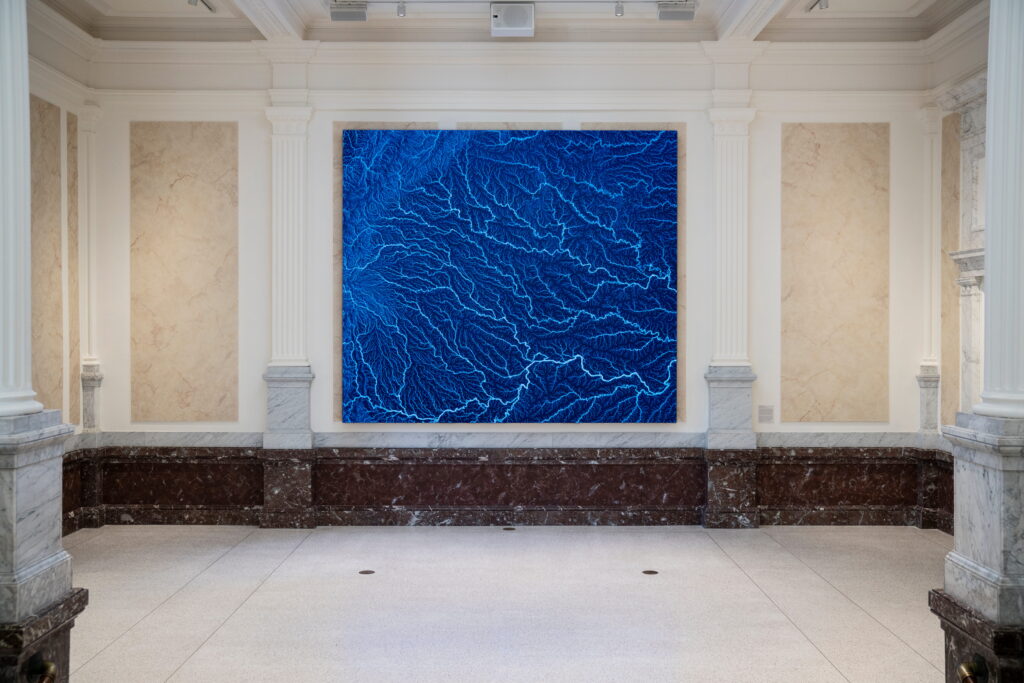
The work takes inspiration from Robert Macfarlane’s Is a River Alive?, where he uses the term “water body” to shift our understanding of water from an inert object to a dynamic process. A river, he writes, is not a container of water but a moving body with structure and memory. It gathers, carries, deposits, erodes, and responds. Water is never still or separate; it circulates continuously through land, air, living systems, and infrastructure, linking them within a continuous planetary network.
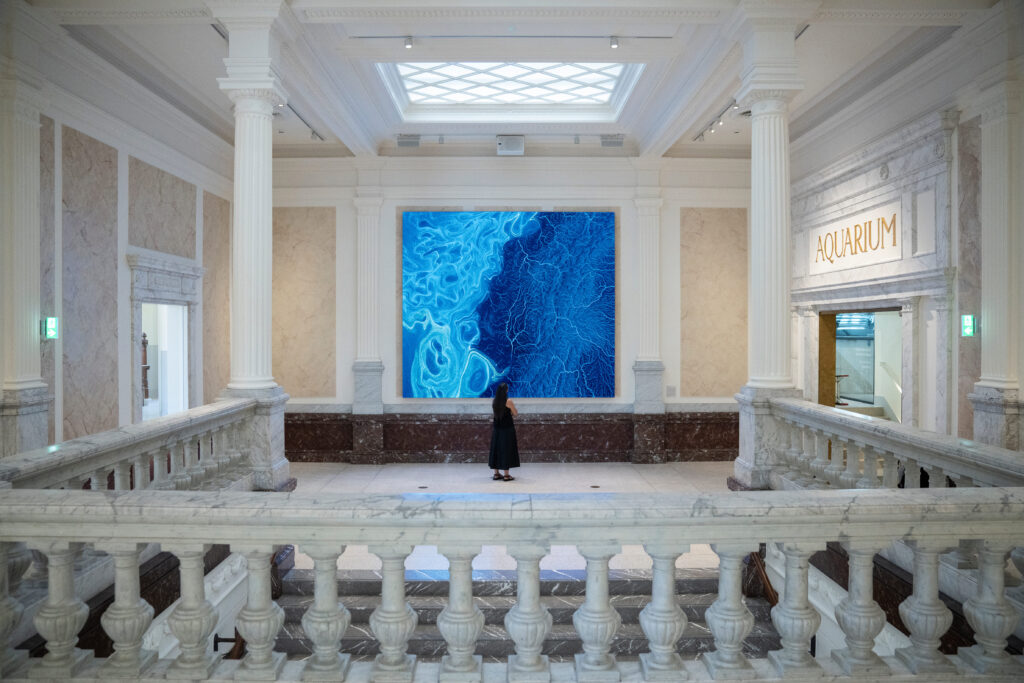
By accelerating time so that an entire year passes in ten seconds, patterns emerge. The Earth, tilted on its axis as it moves around the sun, shifts its shadow continuously between the poles: summer giving way to winter, winter to summer. This axial motion sets everything else in motion. The seasonal shift drives changes in ocean currents, which shape the rhythm of wet seasons and dry seasons across entire continents. In the wet season, rivers swell and carry nutrients out to sea. Those nutrients feed phytoplankton blooms. The blooms sustain krill. The krill draw in seals… and the whole cascade moves through the food chain, the arc of a whale’s migration, it turns out, can be read as a consequence of the Earth’s tilt.
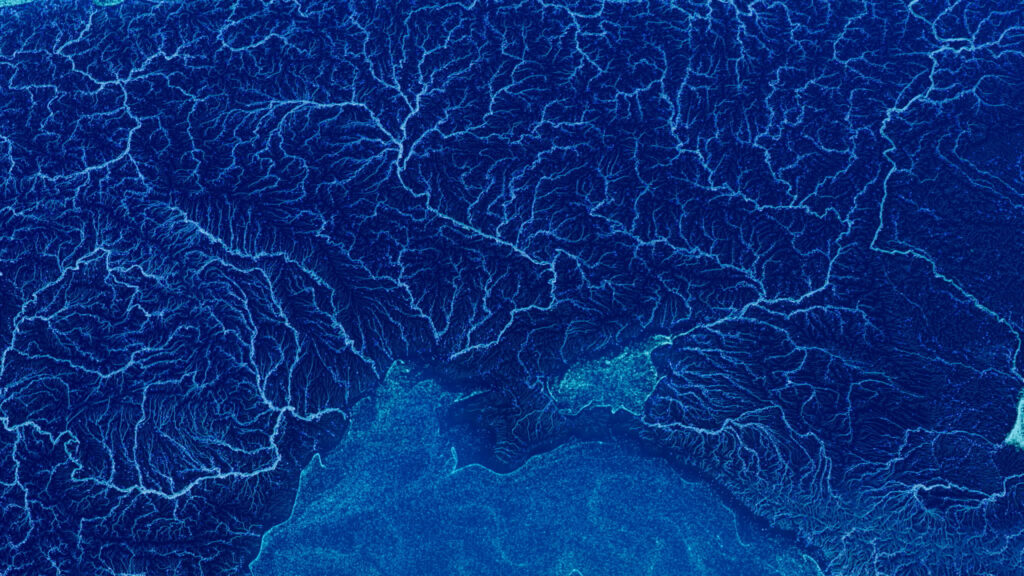
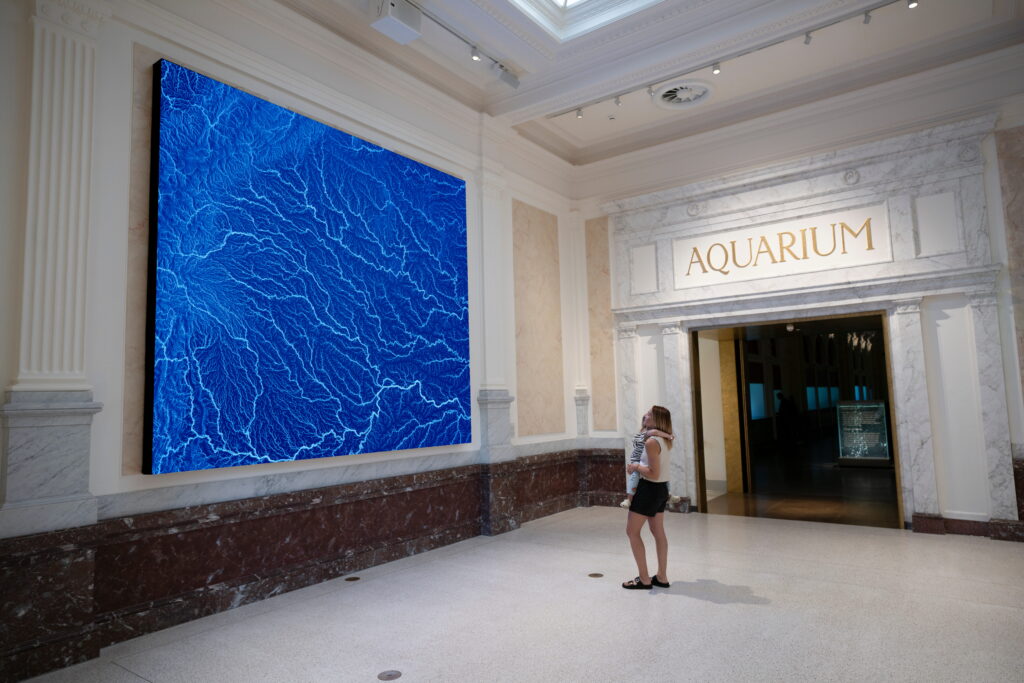
Like the human cardiovascular system, the Earth’s water is in constant motion. Seen from above, the branching river networks resemble arteries and veins, showing planetary flow as a kind of metabolism and an extension of our own human bodies. Treating water as external or separate creates a sense of distance from its state and degradation. Yet microplastics are now present in human blood, and many rivers are no longer drinkable. The work responds to this proximity, suggesting that care for the self is also tied to care for rivers and oceans.
When we understand water as a network rather than a resource, we begin to see that nothing in that network is self-contained or can be understood in isolation. Everything sustains and is sustained by everything else in a web of dependency. Water Body makes that web of dependency visible inviting visitors not just to see water differently, but to perceive more vividly their own place within it.
Data Systems
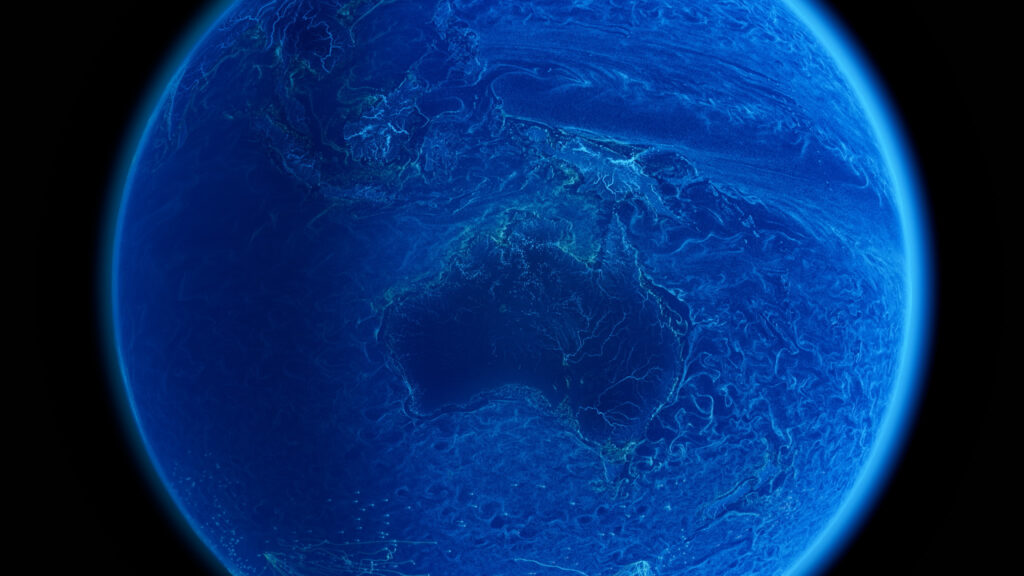
Water Body draws on three primary data sources:
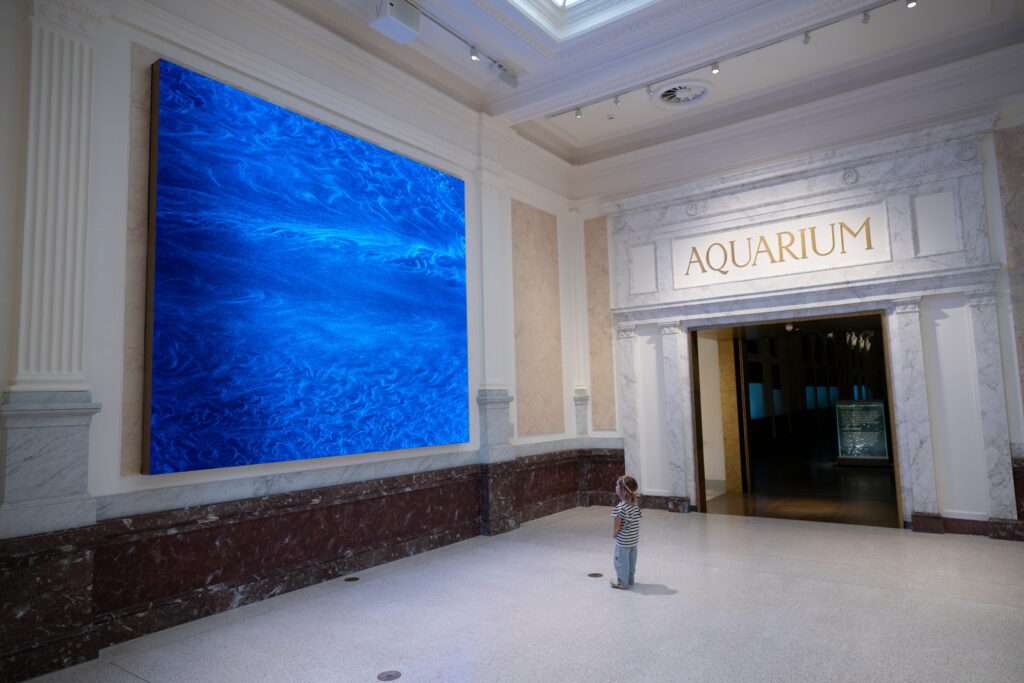
Ocean currents are derived from the Copernicus Marine Service’s Global Ocean Physics Reanalysis (GLORYS12V1), part of Copernicus, the European Union’s Earth Observation programme. Drawing on decades of satellite and in-situ measurements, it provides one of the most detailed global reconstructions of ocean circulation currently available, mapping currents, temperatures, and sea levels at approximately 8 km resolution.
River shapes and routes are derived from HydroSHEDS HydroRIVERS, a global database providing a detailed representation of river networks across every continent.
Their seasonal rhythm swelling and retreating through wet and dry seasons is derived from NASA’s Surface Water and Ocean Topography (SWOT) satellite. Launched in December 2022 and developed jointly with the French space agency CNES, SWOT is the first satellite capable of measuring Earth’s surface water at this scale and level of detail, surveying around 90% of the globe every 21 days. NASA has described the mission as a “quantum leap” for freshwater science.
Phytoplankton Chlorophyll concentration were measured by NASA’s AquaMODIS satellite GPS
Migrating Species
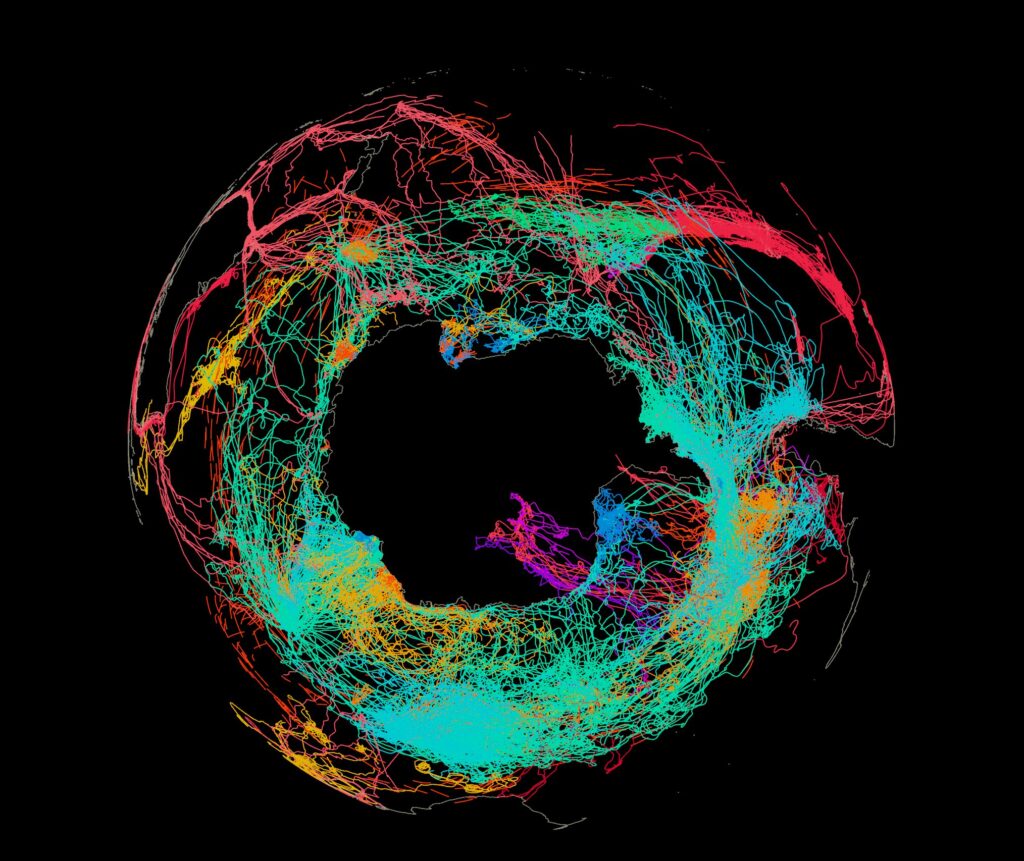
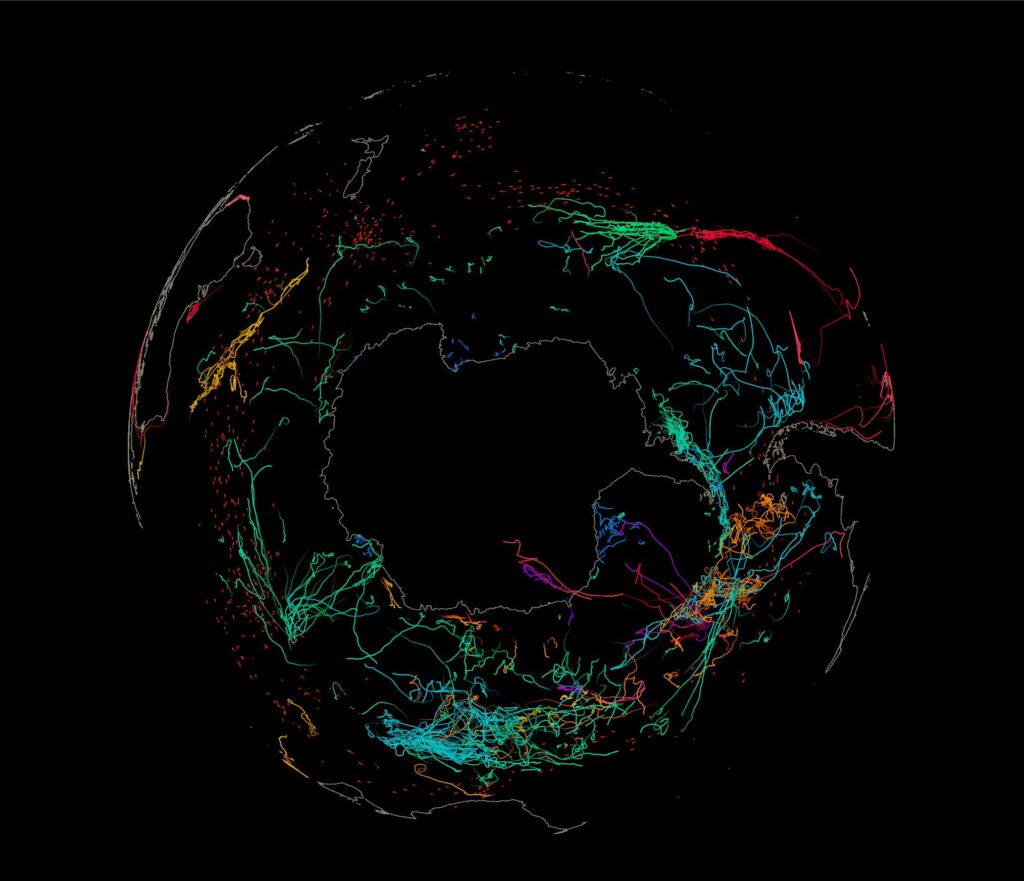
The Earth’s seasonal tilt shifts the shadow from pole to pole, setting ocean currents in motion, influencing rainfall, and carrying nutrients from rivers into the sea. Phytoplankton blooms follow, sending ripples through the food web that carries the movement of migrating species. Their journeys across oceans, coastlines and polar regions unravel from the same interdependent network of currents and seasonal change. A planetary choreography of species and water.
Migration visualisation incorporates movement datasets and scientific contributions from: OBIS-SEAMAP / SeaMap (Duke University), Movebank, EuroBIS / Flanders Marine Institute (VLIZ), SCAR Retrospective Analysis of Antarctic Tracking Data Project.
The species included are:
Albatross, Adelie Penguin, Royal Penguin, King Penguin, Macaroni Penguin, Emperor Penguin, Green Turtle, Juvenile Loggerhead, Loggerhead Sea Turtle, Northern Elephant Seal, Southern Elephant Seal, Crabeater Seal, Antarctic Fur Seal, Weddell Seal, Basking Shark, Fin Whale Humpback Whale, Sperm Whale, Blue Whale, Southern Right Whale.
Sound Design
The sound design, composed by James Bulley, is built from a large archive of field recordings. These include glacial ice movement, river hydrophone recordings, rainfall, wind, and forest environments, as well as biodiversity recordings from the Amazon, the Los Cedros cloud forest and the Galápagos. These recordings are used to reflect natural processes that are not normally audible to the human ear.
As the animation progresses and time is compressed from a year into seconds, the soundscape changes with it. When the viewer moves over different regions, the audio changes to reflect local ecological conditions and biodiversity.
CREDITS
Water Body, 2026
An Artwork by Marshmallow Laser Feast (Ersin Han Ersin, Barnaby Steel, Robin McNicholas)
Commissioned by ARTIS Amsterdam Royal Zoo
For Marshmallow Laser Feast
(Ersin Han Ersin, Barnaby Steel, Robin McNicholas)
Executive Producers: Eleanor (Nell) Whitley, Mike Jones, Alex Rowse
Head of Studio: Sarah Gamper Marconi
Senior Producer: Beccy McCray
Lead VFX Artists: Lewis Saunders, Dan Hoopert, Rosie Emery
VFX Artist: Nicolas Le Dren
Touring Producer: Emmanuel Adanlawo
Senior Producer: Martin Jowers
Communications and Content Manager: Louise Deschamps
Music, Sound Design: James Bulley
Environmental data
Environmental visualisation and modelling incorporates datasets and research from:
NOAA National Centers for Environmental Information (NCEI)
HydroSHEDS / HydroRIVERS
NASA Earth Observatory
GEBCO
NASA / MIT ECCO
Copernicus Marine Service (European Union)
NASA SWOT Mission / PO.DAAC
SWOT River Database (SWORD)
Migration data
Migration visualisation incorporates movement datasets and scientific contributions from:
OBIS-SEAMAP / SeaMap (Duke University)
Movebank
EuroBIS / Flanders Marine Institute (VLIZ)
SCAR Retrospective Analysis of Antarctic Tracking Data Project
For ARTIS
ARTIS | Natura Artis Magistra
Director: Rembrandt SutoriusProject Management: Harrie KnolConcept: Marjolein Drenth, Michèl de Vaan, KOSSMANNDEJONG
BIND Media: Piet-Harm Sterk & team
Sound Design: Studio Dennis Slot
Light Design: Simon Corder
AV Tech: ATA Tech BV